

By Dr Kim-Lim Tan
Humans are always looking for meaning in their lives, and for many, that meaning is found through work. People care more about meaningful work than any other aspect of their careers, including pay, benefits, promotions, and working conditions. According to a recent Ministry of Manpower survey, leveraging employees' skills in their roles and working on interesting/meaningful work were among the top reasons both job switchers and job stayers were enthusiastic about their current jobs. According to a ManpowerGroup Singapore survey, 97% of Singaporeans believe that having a purpose at work is crucial, and more than half (51%) intend to take action to make this happen.
Therefore, meaningful work is no longer an exception. It is becoming an expectation. We are also seeing a more common narrative that meaningful work can be found in leadership, employer branding and also engagement experience. However, it is a more complex phenomenon that calls for more defined boundaries and cautious application, especially by HR professionals.
What is meaningful work?
Meaningful work is more than being happy or satisfied with a job. Even if a person appreciates the companionship, compensation packages, or flexibility of work, one may still feel that the work lacks deeper meaning. On the other hand, work that is perceived as difficult, pressurised, or requiring sacrifice can still feel worthwhile because it connects to something the employee sees as important. We can explain meaningful work as the extent to which employees experience their work as significant, purposeful, and aligned with their values. Specifically, research shows that meaningful work is characterised by (1) being individualised, (2) not self-serving, (3) associated with a singular psychological state, (4) involving characteristic adaptation, and (5) emerging through a process of dynamic construction.
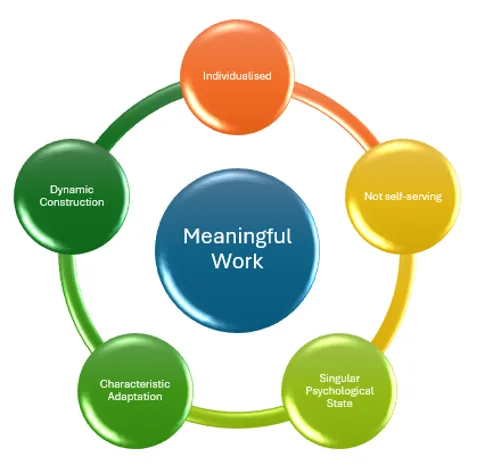
So, whose responsibility is it to create meaningful work?
This has been a perennial question. Is it the employees’ role to find meaning in what they do? Or the organisation’s responsibility to shape the culture?
The answer lies in shared responsibility.
Employees shape meaning by reflecting on their values, identifying how their strengths align with their work, and seeking connections between daily tasks and a broader purpose. The story of the three bricklayers illustrates that meaning depends on individual interpretation, not just the task. Employees who connect their work to a larger purpose are more likely to find it meaningful.
At the same time, organisations also play a key role in enabling meaningful work. They influence job design, leadership culture, growth opportunities, and how employees use their capabilities. Organisations determine whether work feels transactional or connected to a larger purpose. Poorly designed or fragmented roles can make it difficult for employees to find meaning, regardless of their efforts.
The more important question, therefore, is not who owns meaningful work, but how both employees and organisations can co-create it. Meaningful work is rarely something that can be imposed from above or discovered entirely alone. It emerges at the point where individual purpose and organisational context intersect and what matters to employees aligns with what their work enables them to contribute.
Meaning and Performance: Direction of Travel
Research in organisational psychology shows that perceived meaningfulness is linked to outcomes like persistence, engagement, and discretionary effort. Employees who see a clear purpose in their work are more likely to sustain effort during challenges.
However, the direction of causality is not straightforward. While experiencing meaning at work can drive performance, the reverse is also true. Performance often generates meaning. Doing something well, improving over time, and being recognised for it can create a sense of purpose that was not initially present. In practice, this creates a reinforcing loop rather than a single direction. Early meaning can motivate effort. Successful effort builds capability and capability that strengthens meaning.
Double-edged sword
Yet, it is a double-edged sword. The idea that employees who find their work deeply meaningful may tolerate less-than-ideal working conditions is no longer a theoretical proposition. It is observable. A strong sense of purpose can act as a buffer against stress, but it can also mask it. Individuals may rationalise overwork, delay boundary-setting, and normalise unsustainable patterns because the work “matters”. In some professions, particularly those centred on service or caregiving, this mindset has become deeply embedded in organisational culture.
Employers must manage this balance carefully. Relying on employees’ sense of meaning to sustain excessive job demands is risky. If not managed well, any consequential outcome such as burnout tends to be more severe because it follows prolonged overextension. For HR, this is an uncomfortable point - Meaningful work is positive but can carry hidden risks if not balanced with safeguards.
Implications for HR and Business Leaders
As such, employers should be cautious about how they use the language of meaning. It should not become a substitute for addressing basic issues such as workload, role clarity, or managerial quality. If these are weak, appeals to purpose will ring hollow. Regular, structured check-ins that go beyond performance metrics are necessary. In the longer term, the focus should shift from creating meaningful work to designing meaningful work that includes
- Ensuring clear links between individual tasks and organisational outcomes.
- Building roles that support autonomy, skill development and networking.
- Maintaining consistency between organisational values and daily decisions
- Creating space for reflection, not just execution
Closing Thought
Meaningful work is not a universal experience. It is uneven, contextual, and at times fragile. While organisations can shape conditions, individuals will still interpret their work in different ways. When treated carefully, it can strengthen both performance and resilience. When used carelessly, it can obscure and prolong them. The difference lies not only in the concept, but how well it is understood.
About the contributor
Dr Kim-Lim, Tan is currently the senior lecturer at James Cook University (Singapore Campus). He is also the current Head for the Centre for International Trade and Business in Asia.