
By Alvin Aloysius Goh
On National Day, we celebrate what Singapore has built: a tiny island that outpaced the world on every economic metric that mattered.
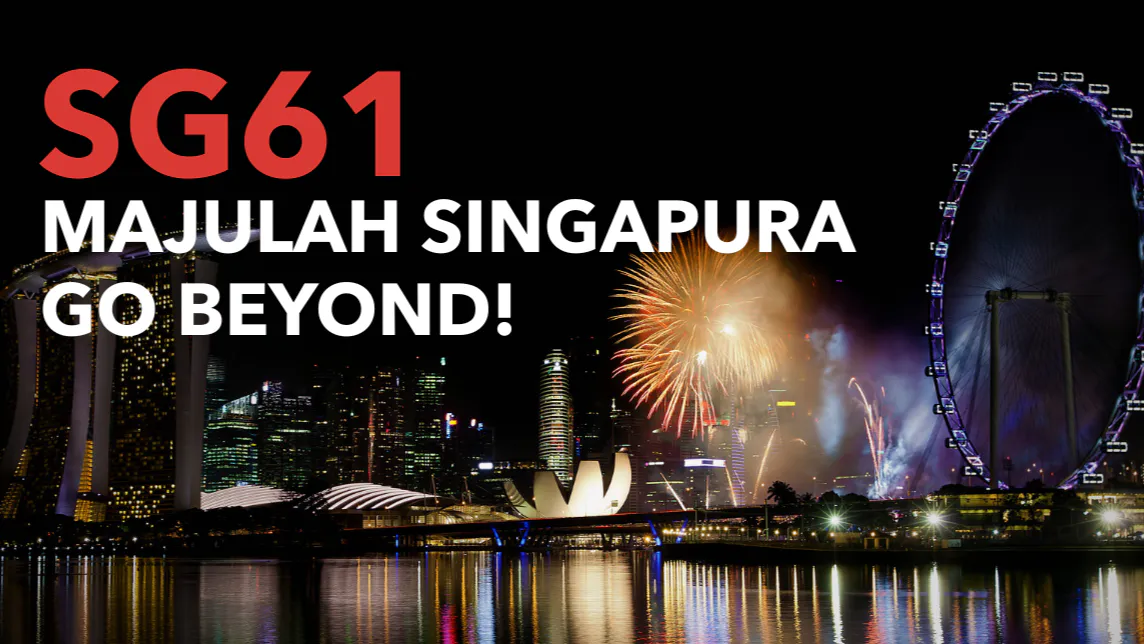
But there's a different question worth asking now, as we turn 61: Beyond what? Beyond growth, beyond efficiency, beyond the structures that got us here? What becomes possible and what becomes necessary in the next nine years till 2035?
Part of the answer lies in Singapore's working life. Not as data points, but in how we define what it means to work, contribute and thrive here by 2035.
Two things must hold true if Singapore is to remain both competitive and human-centred:
- First: Work is fair by design, not by compliance. There is a subtle but important difference between leadership decisions driven by the desire to do what is right and those driven by the need to avoid being wrong.
- Second: AI capability and opportunity are widely distributed across the workforce, not concentrated among a small group of specialists. Every worker should have the literacy and fluency to work confidently alongside AI, regardless of role.
These are the structural conditions that make an economy both human-centred and AI-ready. Without the first, AI will amplify inequality. Without the second, Singapore will fragment into a small elite of AI creators and a much larger workforce watching from the margins.
Most importantly, Singapore's leaders, CEOs, policymakers and HR professionals have the opportunity to make these choices now, rather than allowing them to happen by default.
The Evidence
Singapore's Parliament passed the Workplace Fairness (Dispute Resolution) Bill in November 2025, completing the Workplace Fairness Act. Together, the legislation establishes a framework requiring employers to implement internal grievance handling procedures and, where necessary, resolve disputes through mediation before claims proceed to the Employment Claims Tribunals (ECT) or the High Court. When the Act comes into force in 2027, it will mark an important milestone in strengthening workplace fairness in Singapore.
This is significant. It is only the beginning.
The Workplace Fairness Act is the floor, and not the ceiling. It is a legal baseline that will prevent some harms. What Singapore needs now is a shift to design, embedding fairness into the systems, processes, and decisions that shape working life before unfairness can take root.
The limits of compliance are already visible. While age discrimination in hiring is prohibited, employers may cite secondary reasons for not selecting older candidates, making bias difficult to identify or address. At the same time, the incidence of retrenchment among resident PMEs rose from 8.6 per 1,000 in 2024 to 10.1 per 1,000 in 2025, above the pre-recessionary average.
Senior professionals, in particular, face a structural disadvantage. They often command higher salaries, making them more vulnerable when organisations prioritise cost optimisation. Their expertise may be concentrated in specialised domains that become less relevant as industries evolve. There are also significantly fewer senior positions than mid-level roles, making re-employment inherently more challenging.
While none of these decisions may be unfair in isolation, they produce outcomes that consistently disadvantage the same group of workers. That is precisely why fairness must be intentionally designed into the systems, processes and leadership decisions that shape working life.
On AI and Capability
In January 2026, Singapore updated its National AI R&D (NAIRD) Plan, committing over S$1 billion to public AI research and talent development from 2025 to 2030. Singapore will deepen AI literacy and fluency regardless of ages and job roles, support job redesign, and help workers transition confidently into new roles and growth areas, including through tripartite efforts.
This is the stated ambition, but here is the reality.
In 2026, AI Model & Application Development and AI Literacy became Singapore's hardest-to-find skills, overtaking traditional IT and data capabilities. Demand is accelerating faster than organisations can develop talent. More importantly, while many professionals report strong digital literacy, only around one in five consistently demonstrate the behaviours associated with AI readiness, such as persistence, curiosity and reflective learning. Many also report gaps in decision-making and computational thinking, capabilities increasingly needed to supervise AI, evaluate its outputs and apply it responsibly.
This is the experience debt that organisations now face. AI is entering workplaces faster than people can learn to work effectively alongside it. At the same time, the traditional apprenticeship model is eroding. As AI takes over routine work, entry-level roles are increasingly expected to exercise judgement, creativity, ethics and critical thinking from the outset, even as many organisations anticipate reducing junior hiring. Unless organisations deliberately redesign work and invest in broad-based AI capability, the gap between AI deployment and human capability will continue to widen.
Technology
AI is not inherently fair or unfair. It reflects the choices of the people who design, train and deploy it. Without deliberate safeguards, AI can replicate and amplify existing biases at scale. Encouragingly, AI adoption in Singapore remains largely human-led, with most users retaining responsibility for the thinking behind their work. Preserving that human judgement will be critical as organisations move beyond experimentation towards wider deployment.
Economics
If Singapore's workforce cannot keep pace with AI deployment, productivity gains will eventually stall. If fairness is not embedded into how organisations design roles and develop people, experienced professionals risk being permanently sidelined rather than redeployed. That represents a loss of knowledge, capability and institutional memory that Singapore cannot afford. The economic case is therefore clear. We need to invest in people to sustain Singapore's long-term competitiveness.
Geopolitics and Policy
For over six decades, Singapore's competitive advantage has been built on trust. As global competition in AI intensifies and the technology landscape becomes increasingly fragmented, Singapore's position will depend on whether it remains a trusted, ethical and innovation-ready hub. That requires more than investment in technology. It requires governance that inspires confidence and a workforce equipped to work responsibly alongside AI. Singapore has already articulated this ambition. The next challenge is ensuring that these principles are consistently reflected in how organisations lead, design work and deploy AI.
Society and Trust
Trust is Singapore's most strategic asset. Trust between government and citizens. Trust between employers and workers. Trust between communities.
When fairness is reduced to compliance, that trust begins to erode. Workers see colleagues retrenched without adequate transition support. They watch as AI is deployed in hiring or performance management with no transparency about how it works. Trust erodes visibly.
Building trust therefore requires more than regulation. It requires organisations to demonstrate, through their decisions and actions, that fairness and human potential remain central to the future of work.
Ethics and Philosophy
There is a deeper question beneath all of this: What do organisations owe people whose roles are displaced by technology or restructuring?
Legally, perhaps very little. Ethically, the answer is different.
Singapore's tripartite model has always been built on the belief that economic progress should be shared, not concentrated. Productivity gains should not come at the expense of dignity, nor should workers bear the full cost of change alone.
That is why fairness by design and distributed AI capability matter. One reflects our commitment to making fair decisions. The other reflects our commitment to giving people the opportunity to adapt, contribute and thrive. These are not new ideals. They are a renewal of principles that have shaped Singapore's success for decades.
The Singapore Angle
Singapore is uniquely positioned to turn these ideas into reality.
Few countries have the institutional strengths that Singapore enjoys: a trusted tripartite partnership, strong public policy, an agile business community and a workforce with a longstanding commitment to lifelong learning. The Workplace Fairness Act provides an important foundation.
The National AI Strategy sets a clear direction. But legislation and strategy alone are not enough. The opportunity now is to move beyond compliance towards organisational design, embedding fairness into leadership decisions while ensuring AI capability is developed across the workforce. This is where Singapore can lead, not simply by adopting new technologies faster than others, but by showing how competitiveness, trust and human dignity can reinforce one another.
From Training to Capability
The Singapore Government has repeatedly stressed the importance of AI capability, and we have seen many training programmes emerging. But while many people understand AI, far fewer know how to work alongside it with sound judgement, critical thinking and ethical responsibility.
That is why distributed AI capability should be viewed as a question of business architecture, not merely training. Organisations must redesign work, managers must create opportunities for people to learn alongside AI, and HR must ensure that technology strengthens human capability rather than replacing it.
The Human Question
Ultimately, every organisation in Singapore will have to answer a simple question: Do we want a workforce that grows with us, or one we replace as circumstances change? Everything else follows from that choice. The first demands different investments, different leadership behaviours and different ways of designing work.
It means fairness is more than compliance. It is a commitment to value people beyond their immediate productivity and create meaningful opportunities for them to continue contributing throughout their careers.
It also means AI capability is more than training. It is redesigning work so that AI strengthens human judgement rather than replacing it, and ensuring that every generation of workers continues to learn, adapt and create value.
The journey to SG70 will ultimately depend on this choice. A workforce that does not experience fairness will struggle to trust. A workforce that cannot work confidently alongside AI will struggle to adapt.
Singapore will need both.
The Forward View: What Must Happen by When
Horizon 1: Now to End-2026 (0–18 Months)
What HR Leaders Must Do Now:
- Audit fairness by design. Review hiring, promotion, performance management and role design for structural barriers that unintentionally disadvantage particular groups. Move beyond legal compliance and examine how organisational systems shape outcomes.
- Build AI fluency, not just AI training. AI literacy explains the technology. AI fluency develops judgement, critical thinking and confidence in working alongside it. This capability should begin with every employee, not just AI specialists.
- Demonstrate visible commitment. Do not wait for the Workplace Fairness Act to take effect. Organisations that embed fairness and capability early will gain a competitive advantage in attracting and retaining talent.
Horizon 2: 2027–2030 (18 Months – 4 Years)
What Organisations Should Build:
- Embed fairness into organisational governance. Fairness should become part of how organisations make decisions, just as risk management and financial governance are today.
- Redesign work for the AI era. Entry-level roles should develop judgement, ethics and adaptability, rather than simply replacing routine work with automation.
- Create pathways for experienced talent. Enable senior professionals to continue contributing through mentorship, strategic projects and knowledge transfer, preserving institutional capability rather than losing it.
Horizon 3: 2031–2035 (4–10 Years)
What Institutions and the Profession Must Become:
- Redefine workforce readiness. Success should no longer be measured only by technical competence, but by the ability to work responsibly alongside AI while continuing to learn and adapt.
- Make fairness a competitive advantage. The best organisations will distinguish themselves not because they comply with regulation, but because fairness is embedded into how they lead, hire and develop people.
- Position Singapore as the global benchmark. Demonstrate how economic competitiveness, trusted AI and tripartite partnership can coexist to create sustainable, human-centred growth.
SHRI's Institutional Commitment
Every institution has a role to play in shaping Singapore's next chapter.
For SHRI, that responsibility is to equip the HR profession for the future of work. That is why we are launching our Regional Body of Competency, grounded explicitly in ethics and values, to help organisations move beyond compliance towards fairness by design, while building the capabilities needed for an AI-enabled future. This is not a marketing initiative.
It is our institutional commitment to ensuring that HR does more than manage work. It helps shape the future of work.
The Question for Singapore's Leadership
Singapore at 61 has every advantage: strong institutions, deep talent, trusted governance and the ability to move with purpose. The question is whether we will use those advantages to build an economy that is not only competitive, but also fair. Not only AI-ready, but one that is human-centred.
That choice begins now. The decisions we make over the next few years will shape what it means to work, contribute and thrive in Singapore by SG70.
Beyond growth. Beyond efficiency. Beyond the structures that got us here.
What comes next is ours to design.
Majulah Singapore!