
By Alvin Aloysius Goh
The Silent Contradiction in Singapore's Tripartite Model when it comes to Human Resource Management.
Singapore's tripartite model is often celebrated as a global benchmark where no other countries in the world have such a finely tuned system where government, employers, and unions align to drive economic progress and social stability. It is efficient. It is pragmatic. It works.
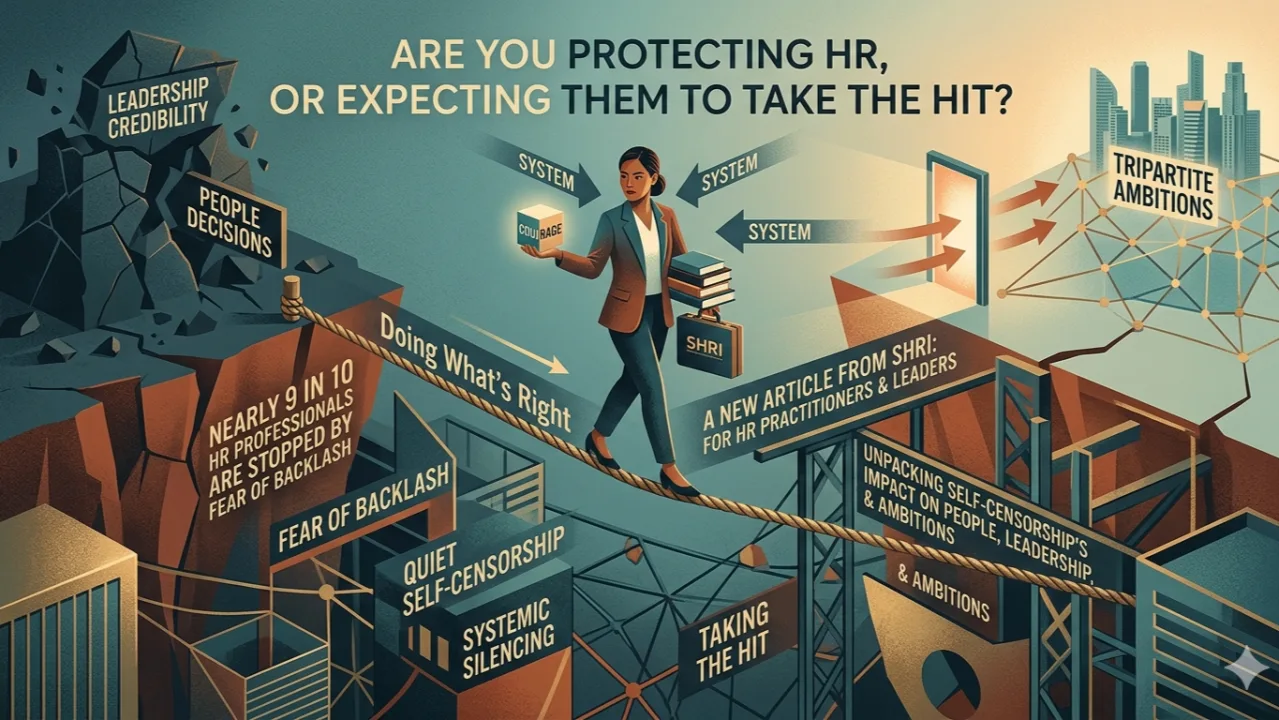
But beneath this success lies an uncomfortable truth that few are willing to confront. When progressive people practices meet organisational resistance, HR is often left standing alone, at times, we are exposed, unsupported, and, too often, sacrificed.
We Asked. The Numbers Answered.
Before we interrogate the system, consider what HR professionals themselves are telling us. SHRI posed a single question to our LinkedIn community:
How often does the fear of backlash stop HR from doing what is right?

Read that again. Only 13% of respondents say fear of backlash has never stopped them from doing what is right.
That possibly means 87% nearly nine in ten HR professionals have at some point self-censored, stood down, or stayed silent when the right course of action would have put them at risk.
Not because they want to, but, perhaps, they feel that they are against a brick wall. Now, before anyone questions the ability of HR professionals, I like all of you reading this post to also ask yourself: have you also thought about backlashes from your line manager, regardless if you are in HR or not?
This is not a character deficit. This is a structural one. And yet, we are taken to task when things go wrong, read all the comments (both positive and negative) ones during the early days of Covid-19 when The Straits Times asked what is the least useful jobs, and HR was one of them.
When 27% of HR professionals report that fear of backlash frequently or almost always shapes their decisions, we are not looking at individual failure. We are looking at a system that has built risk into the very act of doing the right thing but left the people managing the people risk out of the equation.
But First — What Does Right Actually Mean?
The responses to our poll surfaced something important that the numbers alone cannot capture. One of the most thoughtful replies came from Yinn Ewe, who challenged the premise in a way that sharpened it:
Right comes in many shades, and can look different to different people, at different times. Ethics and compliance are non-negotiable — that is the red line. For other people initiatives, what could look right from HRs perspective may not look right from the perspectives of the CEO, or CFO, or even if everyone agrees it is the right thing to do, it may not be the right time. Multiple rights can be right at the same time. — Yinn Ewe
This is not moral relativism. It is organisational realism and it is a distinction the articles central argument must hold.
There are two categories of right at play in most HR dilemmas. The first is non-negotiable: ethics, compliance, legal obligations, and the protection of employee dignity. These are not matters of timing or stakeholder preference. They are the floor. The second category, people strategies, talent investments, flexible work adoption, organisational design involves legitimate trade-offs where timing, context, and business sustainability matter.
HR leaders who conflate these two categories are not just strategically imprecise. They are setting themselves up for the very isolation the poll data describes. And HR leaders who retreat from the first category, the ethics and protection because it feels like the second are failing their professions core mandate.
The system must be designed to make that distinction clearly. And to protect HR when they act on it.
What Backlash Actually Looks Like
Pauline Loo named something in her response that deserves to be said plainly, because the fear of backlash is not abstract, and we should stop treating it as if it were:
HR professionals know the right thing to do — whether to speak up about unfair practices, to challenge poor leadership behaviour, to protect employee dignity, to redesign broken systems — but hesitate because the cost of doing so can feel very real. Potential backlash may come in many forms: from being labelled not commercial, from being excluded from decision-making, from being seen as difficult, from damaging relationships with powerful stakeholders, and from simply standing alone in uncomfortable conversations. — Pauline Loo
This is the architecture of professional silence. And it is not irrational. It is a calculated response to real incentive structures.
When 58% of HR professionals say fear occasionally stops them, they are not describing weakness. They are describing a rational response to a system where courage is not rewarded and where the costs of speaking up can be professionally permanent.
The 22% who experience this frequently and the 5% for whom it is almost always the case are telling us something more alarming: that for a meaningful portion of Singapore's HR community, ethical constraint is not an occasional experience. It is a persistent condition of employment.
Pauline's framing also offers the corrective. Doing what is right does not mean being confrontational. It means having the courage to ask better questions, present evidence responsibly, and remain anchored to both business sustainability and human dignity. Real leadership in HR is, as she puts it, often quiet courage.
The hardest decision, she reminds us, is deciding whether we are prepared to stand for it at all, and believe me, many of the HR Leaders that I have met, have stood up despite possible ‘career-ending moves’.
The Complexity of Context: When Right Meets Ready
Kaustav added a dimension that is easy to overlook when writing from a Singapore vantage point:
Such caution is often justified, especially in a large and long-standing institution. Leadership and audience appetites can differ across countries, and initiatives that succeed in some countries or businesses may fail outright elsewhere. A phased implementation approach might be the best way to push change gradually. — Kaustav
This is the contextual layer that Yinn Ewes framework of multiple rights helps us navigate. What is appropriate in the Singapore headquarters of a multinational may not translate to its operations across the region. What works in a progressive tech firm may fail in a traditional manufacturing environment. HR leaders who ignore this are not braver they are less effective.
But context as justification has limits. A phased implementation approach is strategically sound when we are discussing flexible work adoption or digital HR transformation. It is not acceptable when the issue is discrimination, compliance failure, or systematic exploitation of workers.
Kaustavs point reinforces a discipline that serious HR leaders must develop: the ability to distinguish between strategic patience and moral evasion. To know when to phase and when phasing is simply delay dressed up as prudence.
The Unspoken Reality of "Progressive" HR
We tell HR professionals to champion transformation. Adopt flexible work. Push for mental health support. Redesign jobs for AI. Build inclusive workplaces. Challenge outdated leadership mindsets.
Tripartite bodies including tripartite-owned institutions like IHRP actively advocate for these shifts. Frameworks are commissioned to consulting houses. Certifications and skill badges have their place, but we must ask honestly whether they are translating into better workplace practices or merely signalling compliance. Playbooks and frameworks are important, but without equally strong mechanisms for accountability and practitioner protection, organisations may become better at reporting transformation than actually living it.
But the same system that promotes progressive HR rarely protects HR practitioners when they are forced to confront leaders who resist change.
And resistance is not theoretical. It is real, and it is personal.
Some HR leaders have put the question plainly to SHRI: what exactly is it that you want me to do?
- You expect me to terminate the employee when the line manager has not documented the poor performance of the employee and have cold-storage him?
- Push back against revenue owners and tell them they cannot hire because we need the budget to implement a new tech system?
- Question leadership decisions on restructuring exercises when overseas HQ are not aware of the local practices?
- Advocate for talent development spending when cashflow is under pressure?
I have been fortunate. In several organisations I served, including my current President and Group CHRO were people leaders with the moral clarity and institutional confidence to allow pushback. Not all leaders, however, operate that way.
And when that pushback creates tension, HR is expected to manage the relationship. When transformation fails, HR is blamed for “poor stakeholder management”. When leaders resist, “HR is told they lack influence”.
This is not empowerment. This is exposure.
The Quiet Withdrawal of Protection
Tripartism was built on balance, a shared responsibility across stakeholders. But in the case of HR-led transformation, that balance quietly disappears.
- Policymakers set direction but cannot intervene in organisational power dynamics.
- Employers endorse frameworks but retain the discretion to ignore them.
And so HR professionals absorb the risk alone. No formal escalation pathways. No institutional backing when conflicts arise. No protection when careers are impacted for pushing too hard.
We have built expectations without building safeguards.
The Cost No One Measures
This gap is not just an HR problem. It is a systemic risk and the poll data gives us a way to quantify it that has not existed before.
When 87% of HR professionals are operating in a context where fear of backlash has shaped their decisions, we need to ask: what has not been said? What policies have not been challenged? What restructuring decisions went unchecked because the HR professional in the room calculated, correctly, that speaking up would cost them more than staying silent?
Because over time, HR professionals learn and in fact, my bet is that all employees learn this as well. That’s why quiet quitting exists in some pockets of our workforce, or shall I say, a good majority of the workforce?
At times, HR professionals then have to learn when to push and when to stay silent. We learn which battles are career-limiting. We learn that survival often matters more than transformation. Yet, we learn that we need to be grounded, we learn that we too, need to evolve and change, we learn, that at times, we can do better.
We end up with HR functions that look progressive on paper but remain conservative in practice. Not because HR lacks capability but possibly, the system penalises those who act on it.
None of this should suggest that the picture is entirely bleak. There are organisations in Singapore where HR sits at the table with real influence, where leaders welcome pushback because they understand that tension is where better decisions come from. These are not outliers to be admired from a distance. They are proof that the model works when the conditions are right.
The real question is why those conditions remain the exception rather than the default, and what it would take to change that.
If We Are Serious About Transformation...
Then we need to confront an uncomfortable question: who protects the protector?
If HR is expected to challenge leadership, serve as strategic advisors, and implement nationally endorsed workforce practices, then the system must be designed to support that challenge, not abandon it.
And Kaustavs point about phased implementation matters here too. Systemic change in how we protect HR professionals does not happen in a single policy announcement. It requires sequenced reform and in building the case, piloting mechanisms, measuring outcomes, and scaling what works. The same discipline we apply to workforce transformation must apply to the institutional redesign of HRs authority.
This means rethinking tripartism for the next phase of work:
- Clear institutional backing for HR when implementing nationally endorsed practices and not just endorsement of the framework, but accountability for its enforcement.
- Stronger accountability for organisations that publicly support progressive frameworks but privately resist them.
- Meaningful escalation mechanisms that do not jeopardise HR careers but with the distinction between ethical non-negotiables and strategic trade-offs built explicitly into how those mechanisms work.
- A redefinition of HR's role from business partner to steward of workforce sustainability with corresponding authority and protection.
Because without protection, progressive HR is not a profession. It is a performance, a dance, a show!
A System at a Crossroads
Singapore's strength has always been its ability to evolve ahead of crisis.
But today, the question is not whether we have the right frameworks. It is whether we have the courage to address the contradictions within them.
The poll numbers have named the contradiction. 87% of HR professionals have some level of self-censored in the face of risk. That is not an outlier statistic. That is the lived experience of a profession we are asking to lead transformation. I did not get my transformation going without the backing of my Group CHRO in my banking days, she never wavered and supported me throughout.
As Yinn Ewe said, multiple rights can coexist. Pauline is right: real HR leadership is quiet courage. Kaustav is right: context and pacing matter. But none of these truths justifies a system that places the full weight of that navigation on individual practitioners without institutional support.
If we continue to place the burden of transformation on HR without redistributing power and protection, we are not building a future-ready workforce. We are simply asking HR to take the fall…. again.
And eventually, the system will pay the price for that silence.
Draw the Line… Together
Ethics and compliance are not negotiable. They are the floor, not the ceiling.
SHRI will work with HR professionals, employers, and policymakers to establish a clear institutional distinction between the non-negotiables such as employee dignity, fair employment, legal compliance and the legitimate trade-off space where timing, context, and business sustainability shape decisions. SHRI is after all, an independent HR professional body.
We cannot protect HR professionals if we cannot first agree on what they are being asked to protect. That clarity must be built into every framework, every certification, and every conversation we have with the Ministry of Manpower, National Trades Union Congress (NTUC) and Singapore National Employers Federation (SNEF).
The line must be drawn. SHRI will help draw it with you.
Build the Safeguards — Not Just the Standards
We have spent decades building frameworks. It is time to build protection.
SHRI commits to advocating for formal escalation pathways that allow HR professionals to raise ethical concerns without career consequence. This means working with tripartite partners to design mechanisms, phased, piloted, and measured that give HR practitioners institutional backing when they implement nationally endorsed practices.
87% of HR professionals have self-censored in the face of risk. That is not a courage problem. That is a system design problem. And system design problems require system design solutions.
Reward Quiet Courage — Visibly and Consistently
The HR profession will not change if we only celebrate transformation in hindsight.
Some ideas that HR leaders have told SHRI is to create visible, consistent, and credible platforms, such as through the Singapore HR Awards, the hosting of a conference around Ethics and Values, and our advocacy with professional bodies to recognise HR leaders who demonstrate the quiet courage to ask better questions, present difficult evidence, and remain anchored to both business sustainability and human dignity.
Courage is not confrontation. But it must be seen, named, and rewarded or the next generation of HR professionals will learn, as their predecessors did, that silence is the safer career.
These three are structured to work at both levels simultaneously where the intent is to raise HR professionals to a pledge of solidarity and a call to personal commitment; the policymaker reads an institutional agenda with specific, actionable asks.
A structural problem requires a structural solution. And it requires the quiet courage that Pauline named — multiplied across every HR professional who decides, today, that they are prepared to stand for it. So, reach out to me at alvingoh@shri.org.sg if you have any questions or an issue, we are here to help you, because we are HR!