By Alvin Aloysius Goh
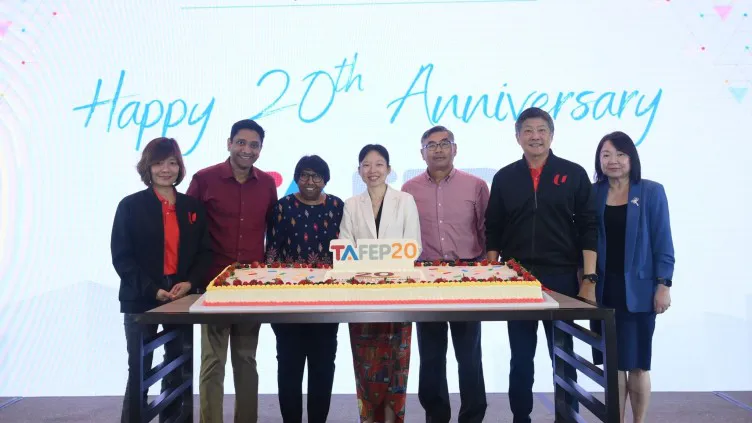
At TAFEP’s 20th anniversary celebration recently, there was a rather memorable cake-cutting ceremony, complete with a very large cake. During the panel discussion, the running joke of sharing that cake with everyone in the audience kept coming up. #IYKYK
It was a simple analogy but it contained an important message.
When organisations do well, how do we make sure employees also get a fair share?
Because when we talk about “Progressive People Practices”, are we only talking about how the cake is divided?
Or should we also be asking what we are building and growing for tomorrow?
At a recent Tripartite Collective session, I asked a simple question that I have been wrestling with: what does “Progressive People Practices” actually mean?
The reality is that the term means different things to different people.
Four lenses, four answers
- Ask an employer, and progressive often means practices that attract good talent, lift productivity and protect and drive business performance.
- Ask an employee, and it means fair treatment, a real voice, room to grow, meaningful work and job security in a time of change.
- Ask the Government, and it may mean workplaces that keep Singapore’s workforce resilient, capable and inclusive, with legislation providing the floor.
- Ask a union, and it may represent shared gains, fair transitions and workers having a say when technology reshapes their jobs.
Each lens is legitimate. Each is also partial.
The risk is that “progressive” quietly becomes whatever the person holding the lever wants it to mean.
But there is another question that I believe all four perspectives must ultimately answer: does what we call progressive contribute to the wider good of society?
After all, an organisation can become more productive, employees can enjoy better benefits, and businesses can become more competitive. These are meaningful gains. But the true measure of progress must also consider what these gains mean for the society we are collectively building.
What I heard on values
During the panel, Acting Minister Jasmin Lau spoke about the importance of ethics and values in organisations.
It was consistent with what she shared during the Committee of Supply debate in March. Speaking about the role of education in an AI age, she put it simply: “If AI can optimise systems, our people must uphold values.”
During the parliamentary motion on an AI transition with no jobless growth, she made the employment version of the same point: “A good job is not just a job that exists.”
I read both as pointing to the same principle. Efficiency is not the only test. Values matter.
But values must go beyond what organisations profess. They need to be reflected in leadership behaviour, the decisions we make and how people experience the workplace.
Values in leadership behaviour are capital.
Why we built SHRI’s APAC Regional HR Competency Model around ethics and values
This is why SHRI designed its Competency Model with ethics and values at the core.
HR pulls many levers, from pay and hiring to restructuring, performance and now AI deployment. Each of these can be pulled in a way that looks progressive from one lens and harmful from another. This is where ethics becomes the common denominator across all four perspectives.
It asks us to look beyond whether a practice works for the organisation, to consider whether it is fair to the people affected by it and whether it makes a positive contribution to society.
In our Competency Model, this shows up in two ways. The first is having the moral courage to voice up when something is not right. The second is bringing our A-game, so that HR creates real business value and earns the credibility to influence the decisions that matter.
Ultimately, values only mean something when they show up in the way we behave, the decisions we make and the actions we take.
A working test before we call anything “progressive”
Here is a short test and my two cents. (Do note that this is an idea and not another framework.)
1. The four-lens test.
Have we genuinely considered what this decision creates, costs and asks of employers, employees, Government and unions?
2. The beyond-compliance test.
Does it go beyond what the law requires, and who actually benefits from the “beyond”?
3. The voice test.
Who carries the cost if this goes wrong, and did they have a say before it was decided?
4. The visibility test.
Can our people see leaders living this, not just reading about it?
AI makes these questions sharper, not softer. The more capable our systems become, the more important these human judgements will be.
The golden thread
These questions were also on my mind during a recent NTUC COMPACT dialogue on the importance of tripartism, with NTUC Secretary-General Ng Chee Meng. As I listened to the discussion, I kept asking myself the same question: what holds different interests together when each has its own definition of progress

Here is where I have landed.
The four lenses may never fully agree, and sometimes, they are not meant to.
Tripartism has never been about the absence of disagreement. It is about what each party is willing to give up, and why. Our history shows this clearly.
During the 1985–86 recession, unions accepted painful wage and CPF adjustments because keeping jobs mattered.
The Progressive Wage Model later linked pay increases for lower-wage workers to skills and productivity. Employers took on the cost while workers took on upgrading.
Today, as AI reshapes jobs, the same question is emerging again: how do businesses transform while ensuring workers have a fair opportunity to transform with them?
None of these were free.
Progress required different parties to make sacrifices. Trade-offs alone, however, do not hold for six decades. What holds them is a shared belief that the sacrifice serves something larger: the good of the country and its people.
That is the golden thread.
It is also where tripartism and ethics meet. A trade-off without shared values is just a transaction. It lasts until one side finds a better deal.
A trade-off anchored in the common good builds trust that can be drawn on in the next crisis.
This is what I mean when I say “progressive” must contribute to society.
It is tripartism brought down to the level of the organisation. Every time an HR leader pulls a lever, they are running a small tripartite negotiation between the business, its people and the wider community.
The question is whether the golden thread runs through it.
Which brings me back to the cake.
Sharing the cake matters. But progressive people practices must also ask whether we are creating something sustainable enough to keep sharing tomorrow.
What we call progressive today may become tomorrow's norm. And as the needs of businesses, workers and society evolve, so too will our understanding of what is progressive.
But through these changes, our ethics and values must remain steadfast. They are what guide the trade-offs we make, especially when the interests of different parties do not fully align.
Perhaps that is what truly makes a people practice progressive: our ability to move forward together, guided by shared values and a commitment to the greater good.