By Alvin Aloysius Goh
The 2025/2026 National Wages Council (NWC) Guidelines mark one of the most significant shifts in Singapore’s manpower landscape in recent memory. While wages remain a central focus, the broader message points to something deeper. Competitiveness can no longer be achieved simply by offering higher pay. It depends on transforming jobs, redesigning work and recognising skills as the true engine of organisational growth.
Across the guidelines, the tripartite partners have sent four clear signals that employers should not overlook.
1. Singapore moves towards a skills-first, productivity-anchored wage environment
The NWC highlights the need to link wage growth closely with productivity improvements, and calls for full adoption of the Flexible Wage System (FWS). The direction is unmistakable that companies that do not invest in transformation, training and modernisation will find it increasingly difficult to sustain wage growth.
This positions wage progression less as a discretionary HR decision and more as a reflection of an organisation’s capability development and digital transformation roadmap. Wages become a language of trust and alignment, not merely a hygiene factor.
2. Uplifting Lower Wage Workers (LWW) is now a structural mandate
The recommended increases of 5.5 to 7.5 per cent or at least $105 to $125 place firm emphasis on narrowing wage inequality. The intent is decisive.
For employers, this requires more than simple compliance. Business models, workflows and job scopes must be redesigned so that productivity gains keep pace with mandated wage growth. This is now a structural cost planning reality. Organisations must generate real value or risk being priced out of the market.
3. Occupational Progressive Wages (OPW) expansion signals broader job transformation ahead
The updated job ladders for Administrators and Drivers reflect a growing complexity of job roles shaped by AI, digital tools and multi skilling needs. Even traditionally manual or routine roles are evolving toward higher value work.
This expansion is a precursor to more occupational groups undergoing similar transformation in the years ahead.
4. Workforce transformation is now tied to business survival
The guidelines highlight falling training incidence, untapped job redesign opportunities, growing risks of skills obsolescence and strong financial support for companies that transform. The message is direct. Firms that do not transform will lose competitiveness within the next three to five years.
HR must adopt an outside in mindset and shift from being compliance driven to becoming a strategic partner.
HOW EMPLOYERS CAN RESPOND
SHRI encourages organisations to focus on six priority areas.
A. Treat the Flexible Wage System as a strategic tool
Most organisations implement FWS mechanically. SHRI recommends revisiting its design so that variable components reinforce the behaviours and outcomes the organisation wants to encourage.
This may involve:
• Recalibrating the Annual Variable Component (AVC) and Monthly Variable Component (MVC)
• Tying variable pay to digital adoption, efficiency, skills acquisition and service quality
• Using transparent dashboards to communicate wage adjustments
Doing so builds trust, strengthens the connection between performance and pay, and supports agility during economic shifts.
B. Build a unified Skills Productivity Wage Framework
HR should integrate wage progression with skill mastery, digital literacy, multi skilling and job redesign outcomes.
A structured Skills Productivity Wage (SPW) Matrix should define:
Job Role | Required Skills | Required Tech Tools | Redesigned Duties | Productivity Metrics | Wage Tier
This forms the basis for career progression, performance evaluation, salary structuring and training priorities.
C. Approach lower-wage workers uplift as business transformation
Instead of treating increases as a cost burden, HR should redesign work to create value. This includes automation of repetitive tasks, digital upskilling, productivity allowances and outcome-based contracting.
When executed well, lower-wage workers uplift can become self-funding through productivity gains.
D. Implement OPW through genuine job redesign
The expanded job ladders for Administrators and Drivers require more than reclassification. Employers must redesign roles, update job descriptions, create clear career pathways and invest in structured training.
This supports compliance and sets the organisation up for long term productivity gains.
E. Make training a management KPI
The decline in training incidence is a warning. Line managers must be held accountable for skills utilisation and development.
HR should institutionalise:
• Minimum learning hours
• Structured career conversations
• Protected learning time
• Skills utilisation KPIs
• Mandatory upskilling for digital roles
Employers should also tap on grants such as Career Conversion Programmes (CCPs), SkillsFuture Enterprise Credit (SFEC), and the Workforce Development Grant.
F. Strengthen HR capability and shift into a strategic role
The guidelines underscore the need to elevate HR capability. HR must strengthen workforce analytics, job redesign expertise, talent intelligence, AI deployment and skills first workforce planning. These capabilities allow HR to drive long term business competitiveness.

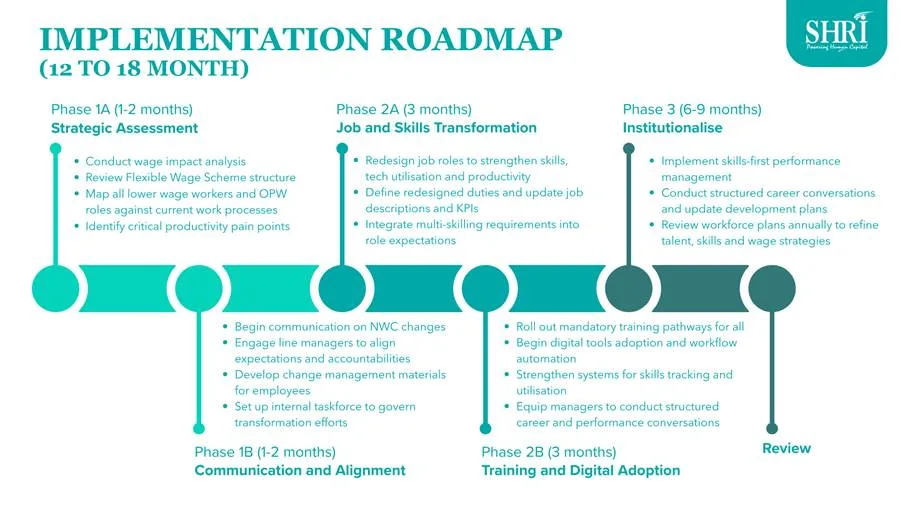
A 12 TO 18 MONTH IMPLEMENTATION ROADMAP (Chart)
Phase 1: Foundation (0 to 3 months)
• Conduct wage impact analysis
• Review FWS structure
• Map LWW and OPW roles
• Begin communication and change management
Phase 2: Build and Transform (3 to 9 months)
• Redesign job roles
• Implement the SPW framework
• Roll out mandatory training pathways
• Strengthen digital adoption
Phase 3: Institutionalise (9 to 18 months)
• Embed wage productivity dashboards
• Implement skills first performance management
• Conduct structured career conversations
• Review workforce plans annually
Final Advisory to HR Leaders
The NWC Guidelines are not merely a compliance reference. They provide a strategic lens into the future of work in Singapore. Organisations that act early and build workforce transformation into their operating DNA will strengthen competitiveness, enhance productivity, retain talent, and build a fair and progressive workplace culture. These are the organisations that will lead Singapore’s next chapter of manpower advancement.